Why Industry Exposure Matters for Engineering and Management Students
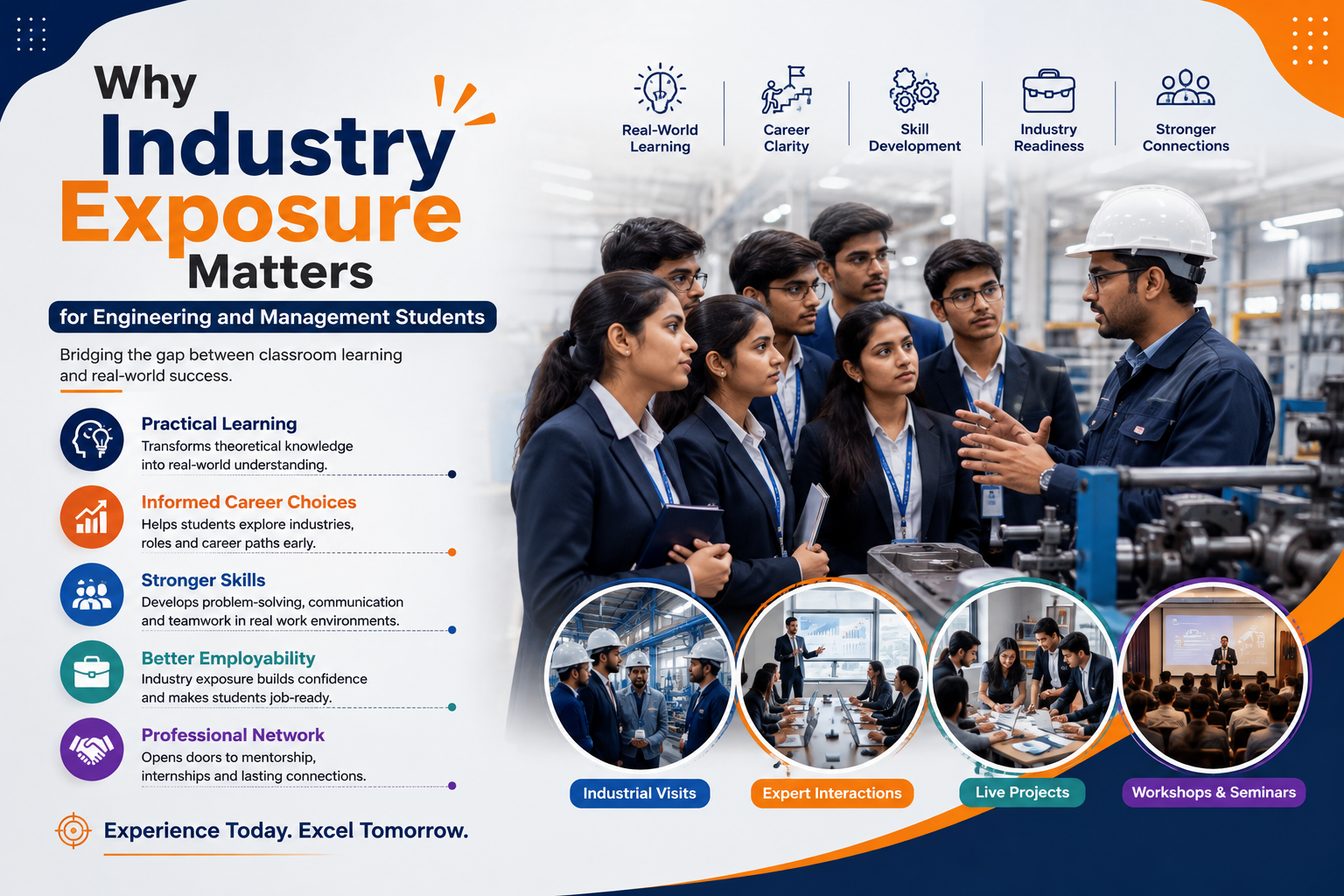
A college education is not limited to textbooks, lectures, assignments, and examinations. In today’s competitive professional environment, students also need practical knowledge, workplace awareness, communication skills, and an understanding of how their academic concepts are applied in the real world.
This is where industry exposure for college students becomes important.
Whether students are pursuing engineering, management, computer applications, or business studies, exposure to professional environments can help bridge the gap between classroom learning and industry expectations.
What Is Industry Exposure?
Industry exposure refers to opportunities that allow students to understand and experience the professional world while they are still pursuing their education.
It can include industrial visits, internships, live projects, workshops, expert lectures, corporate interactions, training programmes, case studies, and placement activities.
These experiences allow students to understand how organisations work and how the concepts they learn in classrooms are applied in professional situations.
1. Connects Classroom Learning With Real-World Applications
One of the biggest benefits of industry exposure is that it helps students understand the practical side of their subjects.
For example, an engineering student may learn about technology, production, software, electronics, or infrastructure in the classroom. Visiting an organisation or working on a practical project can help the student understand how these concepts are implemented in an actual workplace.
Similarly, management students can understand how marketing, finance, human resources, operations, and business strategies are applied within organisations.
This connection between theory and practice can make learning more meaningful and engaging.
2. Helps Students Understand Industry Expectations
Students often wonder what employers expect from fresh graduates.
Industry interactions can provide valuable insights into professional requirements such as technical knowledge, communication skills, teamwork, problem-solving, leadership, time management, and adaptability.
Understanding these expectations early can encourage students to work on the skills they need during their college years.
3. Develops Professional Skills
Academic knowledge is important, but professional success also requires strong interpersonal and workplace skills.
Industry exposure gives students opportunities to interact with professionals, work in teams, communicate ideas, solve practical problems, and take responsibility.
These experiences can help students become more confident and comfortable in professional environments.
4. Provides Valuable Career Insights
Choosing the right career can be challenging when students have limited knowledge about different industries and job roles.
Industrial visits, internships, expert sessions, and corporate interactions can expose students to different career possibilities.
Engineering students may discover opportunities in areas such as software, manufacturing, electronics, infrastructure, data, and emerging technologies.
Management students can explore careers in marketing, finance, human resources, operations, business analytics, consulting, and entrepreneurship.
Such exposure can help students make more informed career decisions.
5. Encourages Practical Problem-Solving
Real-world problems are often different from textbook questions.
In professional environments, students may encounter situations that require them to analyse information, work with others, make decisions, and develop practical solutions.
Live projects and industry-oriented assignments encourage students to develop these abilities.
Instead of only asking, “What is the correct answer?”, students begin thinking about:
“How can this problem be solved effectively?”
This change in approach can be valuable for future professionals.
6. Builds Professional Confidence
Entering the professional world for the first time can feel challenging.
Students who have participated in industrial visits, internships, workshops, or professional interactions may feel more familiar with workplace environments.
Meeting industry professionals and participating in practical activities can gradually improve confidence and communication skills.
This confidence can also be useful during interviews, presentations, group discussions, and campus recruitment.
7. Helps Students Build Professional Networks
Industry interactions can provide students with opportunities to connect with professionals, mentors, recruiters, and organisations.
These connections can help students learn about career opportunities, internships, industry trends, and emerging skills.
Professional networking is not simply about finding a job. It is also about learning from experienced professionals and understanding different career paths.
8. Makes Students More Career-Ready
Employers increasingly value graduates who can adapt to professional environments and apply their knowledge effectively.
Industry exposure can help students become familiar with workplace expectations before graduation.
When academic learning is combined with practical projects, internships, skill development, and professional interaction, students can develop a stronger foundation for their future careers.
Industry Exposure in Engineering Education
For engineering students, practical exposure can be particularly valuable.
Engineering is a field where theoretical concepts are closely connected with real-world applications. Industrial visits, laboratory work, technical workshops, live projects, internships, and technology-based activities can help students understand how engineering principles are used in different industries.
Exposure to emerging technologies can also encourage students to explore new areas and develop relevant technical skills.
Industry Exposure in Management Education
Management students also benefit greatly from practical exposure.
Business decisions involve more than theoretical concepts. Students need to understand customers, markets, employees, financial considerations, operations, competition, and changing business environments.
Case studies, corporate interactions, internships, seminars, and practical projects can help management students understand how different business functions work together.
How Colleges Can Create Better Industry Exposure
Colleges can provide industry-oriented learning through various activities:
Industrial Visits: Students can observe professional workplaces and understand organisational processes.
Internships: Students can gain direct experience by working in professional environments.
Live Projects: Students can work on practical challenges and apply their academic knowledge.
Expert Sessions: Industry professionals can share insights about current trends, skills, and career opportunities.
Skill Development Workshops: Students can develop technical and professional skills relevant to their chosen fields.
Placement Training: Career-focused training can help students prepare for interviews, aptitude tests, group discussions, and workplace expectations.
Industry-Oriented Learning at CERT College
At CERT College Meerut, students are provided opportunities to complement academic learning with practical and industry-oriented experiences. The institution offers programmes including B.Tech, MBA, BBA, and BCA, with a focus on skill development, practical learning, internships, workshops, industrial exposure, and career preparation.
Such opportunities can help students understand professional environments, develop relevant skills, and prepare themselves for the changing requirements of the industry.
Preparing Students for a Changing Professional World
Industries continue to evolve because of technological advancements, automation, digital transformation, changing customer expectations, and emerging business models.
Students therefore need to remain adaptable and continuously develop their knowledge and skills.
Industry exposure can help students understand these changes while they are still in college. It encourages them to stay curious, learn new technologies, improve communication, and understand the practical requirements of their chosen career.
Conclusion
Industry exposure can play an important role in preparing college students for professional life.
It helps connect classroom concepts with real-world applications, develops practical and communication skills, provides career insights, encourages problem-solving, and builds professional confidence.
For engineering and management students, college is an ideal time to explore industries, interact with professionals, participate in practical projects, and understand workplace expectations.
A strong combination of academic knowledge, practical learning, and industry exposure can help students move from classroom learners to career-ready professionals.