GPT-6 Astra: A New Era of AI Intelligence and What It Means for Students
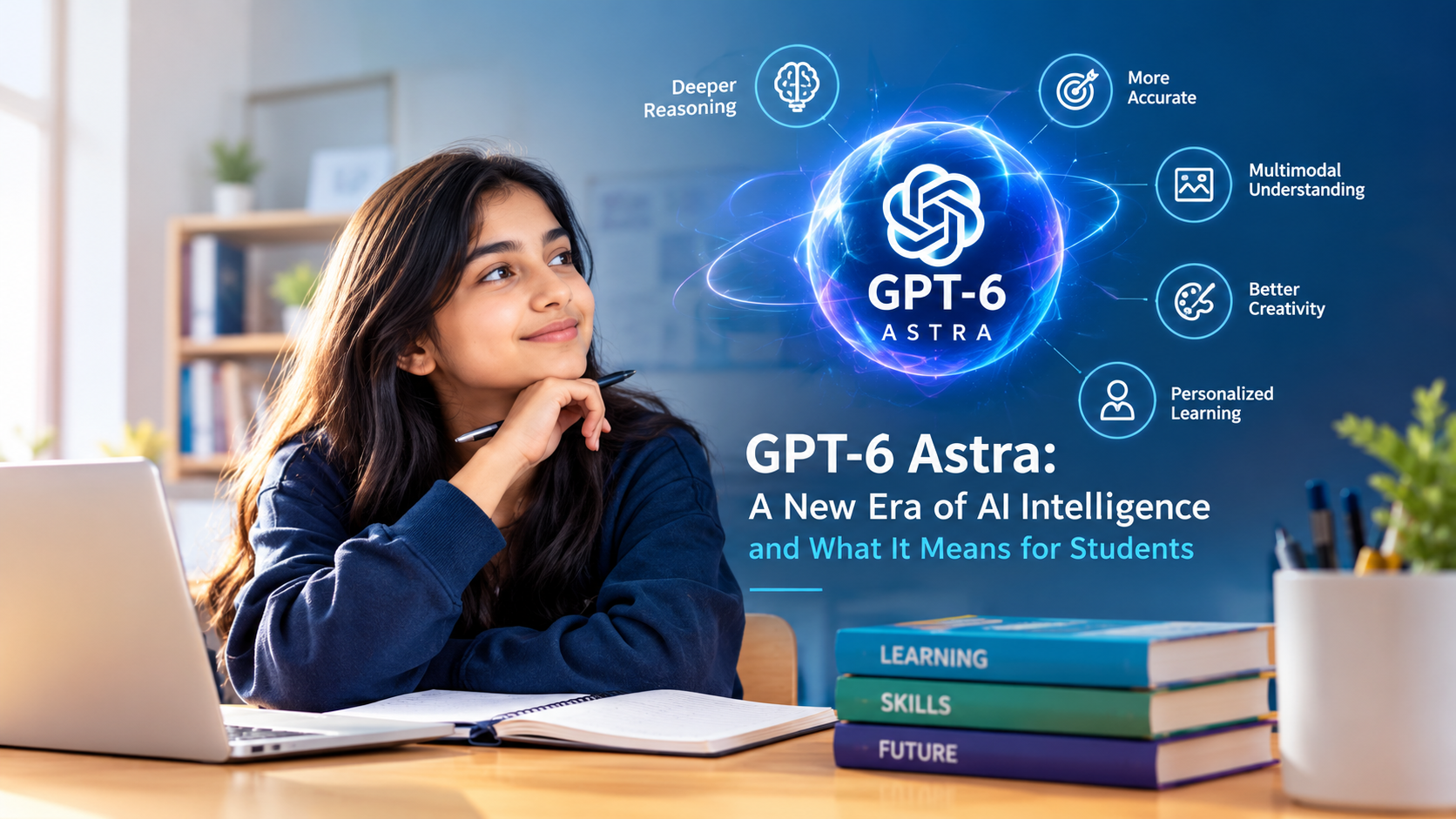
Artificial Intelligence is moving faster than ever, and GPT-6 Astra represents another major milestone in that journey. Introduced by OpenAI in September 2026, Astra is designed to handle complex reasoning, software engineering, computer use, research, cybersecurity, and professional workflows.
For students, educators, engineers, developers, and future professionals, this development raises an important question:
How will advanced AI change the way we learn, work, and build the future?
What Is GPT-6 Astra?
GPT-6 Astra is OpenAI's latest flagship AI model, built for demanding end-to-end tasks. According to OpenAI, it combines advances in pre-training, reinforcement learning, and alignment to improve its ability to reason and complete multi-step tasks.
Unlike AI systems that primarily generate text in response to questions, Astra is designed to work across computers and software environments. It can assist with activities such as research, coding, document creation, browser-based workflows, data analysis, and other professional tasks.
Smarter Reasoning and Problem Solving
One of the most important developments in modern AI is the ability to solve increasingly complex problems.
OpenAI reports that GPT-6 Astra achieves a 99.9% score on ARC-AGI-3 and a 98% score on FrontierMath Tier 4, highlighting its performance on challenging reasoning and mathematics evaluations.
For students, the significance goes beyond benchmark scores. Advanced reasoning systems can potentially become powerful learning assistants—helping students explore concepts, test ideas, analyze problems, and receive explanations from different perspectives.
A New Generation of AI Coding
Software development is another area where Astra is expected to make a significant impact.
The model is designed to assist with complex software engineering tasks, including writing and debugging code, working with development environments, and handling longer multi-step programming workflows.
For engineering and computer science students, this creates an important opportunity.
Instead of viewing AI only as a replacement for coding tasks, students can learn to use AI as a development partner while strengthening their own programming fundamentals.
The most valuable combination will be:
Programming Knowledge + AI Skills + Problem-Solving Ability
AI Agents and Computer Use
Perhaps one of the most significant changes is the growing ability of AI systems to interact with computers.
GPT-6 Astra is designed to perform tasks such as navigating websites, working with software, preparing documents and spreadsheets, conducting research, and completing multi-step workflows.
This points toward a future in which AI agents can handle repetitive digital tasks while humans focus more on decision-making, creativity, strategy, and innovation.
What Does GPT-6 Astra Mean for Students?
The arrival of increasingly capable AI does not mean that students should stop learning traditional skills.
Quite the opposite.
Students need to develop a combination of technical knowledge and uniquely human capabilities.
Students should focus on:
Programming and computational thinking
Data analysis and interpretation
Artificial intelligence and machine learning
Cybersecurity fundamentals
Critical thinking
Communication skills
Creativity and innovation
Problem-solving
Teamwork and leadership
Responsible and ethical use of AI
AI tools can provide answers, but students must learn how to ask the right questions, verify information, understand context, and make responsible decisions.
AI and the Future of Engineering Education
Engineering education is entering an exciting period.
Students can now combine traditional engineering disciplines with AI to create innovative solutions in areas such as:
Smart manufacturing
Robotics
Autonomous systems
Healthcare technology
Smart cities
Cybersecurity
Renewable energy
FinTech
Software engineering
Data science
This means that the engineers of tomorrow will not simply be technology users. They will increasingly become technology builders and AI-enabled problem solvers.
The Importance of Responsible AI
Greater AI capability also brings greater responsibility.
OpenAI's safety documentation notes that GPT-6 Astra represents a significant increase in cybersecurity capability and that additional safeguards and monitoring were introduced for its deployment.
As AI becomes more powerful, students and professionals must understand issues such as:
Data privacy
Cybersecurity
AI bias
Academic integrity
Responsible automation
Human oversight
Ethical decision-making
Learning how to use AI responsibly will be just as important as learning how to use it effectively.
The Future Is Human + AI
The biggest opportunity created by GPT-6 Astra is not simply faster AI.
It is the possibility of people and AI working together to solve problems that were previously difficult or time-consuming.
Students who learn to combine their education with emerging AI technologies can position themselves for a rapidly changing employment landscape.
The goal should not be to compete against AI.
The goal should be to become better at using AI to create value.
Preparing Students for the AI Era
At College of Engineering & Rural Technology (CERT), Meerut, technology-focused education can play an important role in preparing students for tomorrow's opportunities.
As AI continues to transform industries, students should develop strong academic foundations while also gaining practical exposure to programming, emerging technologies, projects, innovation, and real-world problem solving.
The future will belong to professionals who can continuously learn and adapt.
Conclusion
GPT-6 Astra is another significant step in the evolution of artificial intelligence. Its advances in reasoning, coding, computer use, research, and professional workflows demonstrate how quickly AI capabilities are developing.
For today's students, this is more than a technology story.
It is a reminder that the skills we learn today will shape the technology we build tomorrow.
The question is no longer simply “How powerful is AI?”
The more important question is:
“What will you build with it?”